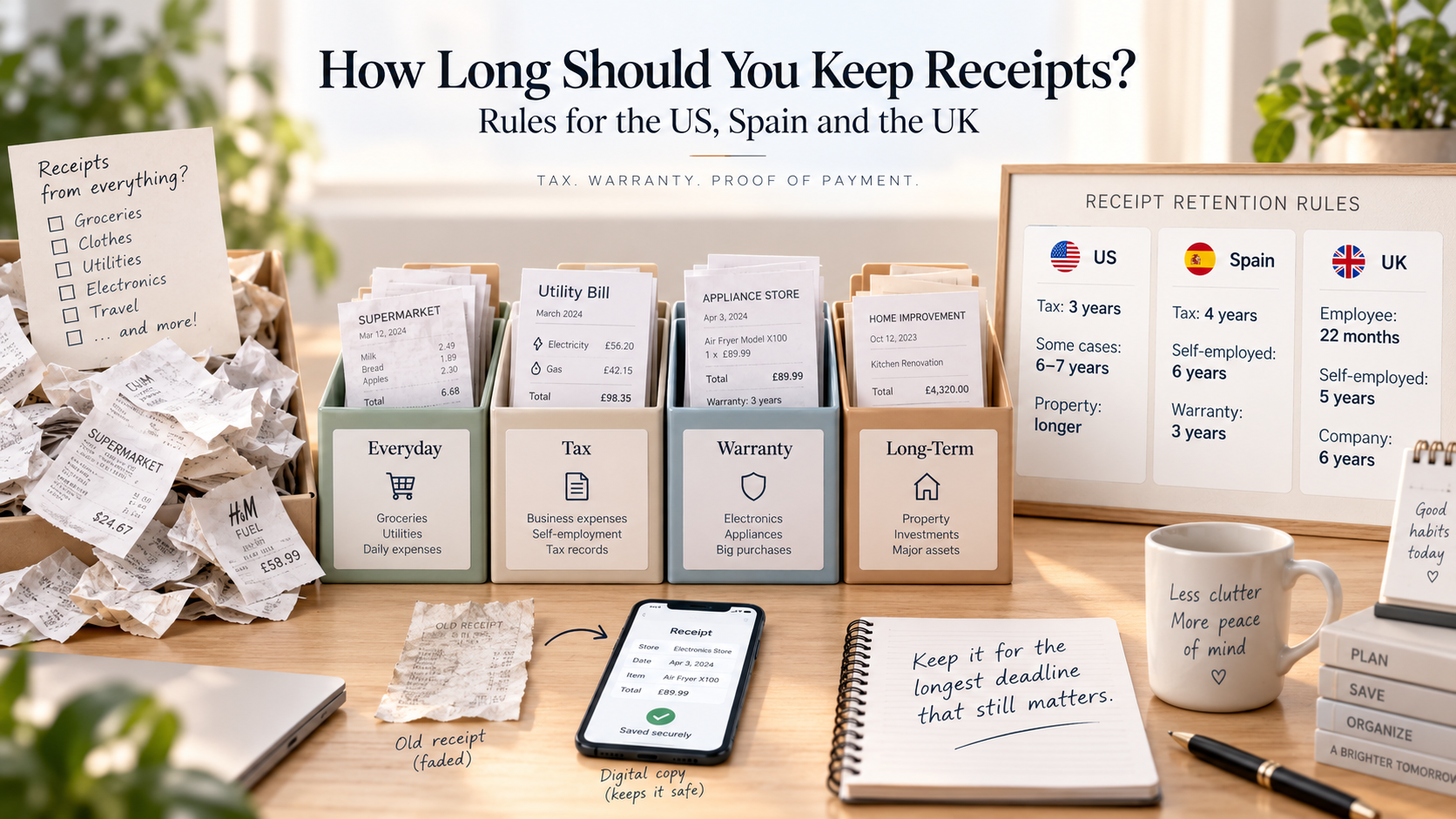
How Long Should You Keep Receipts? Rules for the US, Spain and the UK
Last verified against official sources: September 2026
There's a drawer. You know the one. It has a dead pair of headphones in it, three takeaway menus, and about four years of receipts compressed into a solid brick, most of which are now blank because thermal paper doesn't age well.
Twice a year that drawer becomes relevant. Once when something breaks and you need proof of when you bought it. Once when your accountant asks a question you can't answer. Both times you find out the brick was useless, and you resolve to throw everything away, which is exactly the wrong lesson.
Receipts do have expiry dates. They're just not the ones people assume, and they're different in every country. Here are the actual numbers, with links to the rules they come from.
The short answer
| Country | Standard tax retention | The clock people forget |
|---|---|---|
| United States | 3 years after filing. 6 or 7 in specific cases, indefinitely if you never filed | 4 years from delivery for a breach-of-warranty claim (UCC §2-725) |
| Spain | 4 years for tax, 6 years if you're self-employed | 3 years of legal guarantee, plus 5 years to bring the claim |
| United Kingdom | 22 months after the tax year for employees, 5 years after the filing deadline if self-employed | 6 years to claim under the Consumer Rights Act, 5 in Scotland |
The pattern is the same everywhere: consumer-protection deadlines regularly outlive tax deadlines. The tax office isn't the reason you're keeping the receipt for the dishwasher.
Why bother keeping receipts at all
A receipt is doing five jobs at once, and each one runs on its own clock.
It proves a deduction. Every tax authority works the same way here: you claimed it, so evidence it. No paper, no deduction, no argument.
It proves you bought the thing. Warranty claims, returns and repairs all start with when and where.
It proves you paid. A utility receipt isn't a purchase record, it's evidence that a debt is gone. That distinction matters the day someone says it isn't.
It proves a date. Insurance claims and guarantee periods turn on the calendar, not the amount.
It sets your cost basis. Renovation invoices reduce the taxable gain when you sell a property, which might be twenty years from now. That's the receipt most people bin.
And then there's the sixth job nobody legislates: knowing where your money actually went last month. That one needs the numbers, not the paper.
One clarification before the country sections, because it's widely misunderstood in both directions. There's no blanket legal duty to keep every receipt you're ever handed. But the moment a receipt supports something official, that changes. If it backs a deduction on a return, a claimed credit, a business expense or a statutory obligation, retention rules apply to it, and they apply to private individuals as much as to companies. The test isn't who you are. It's what the document is being used for.
Not all receipts run on the same clock
This is where most advice goes wrong. Five things that all look like "a receipt" answer to five different laws.
| Document | Governed by | Realistic clock |
|---|---|---|
| Shop till receipt | Consumer law, plus tax law if deductible | Warranty period, up to 3 years in the EU |
| Utility bill | Sector regulation and limitation on periodic debts | 1–5 years, depending on country |
| Payment confirmation | Contract and civil law | Until the debt can no longer be claimed |
| Bank transfer record | Civil law, plus your bank's own retention | Length of the underlying obligation |
| Private IOU or handwritten receipt | Civil limitation periods | Often the longest of the lot |
The rule underneath all of it: a receipt's retention period is set by the longest deadline it can still be used against, not by the date printed on it.
How long to keep receipts in the United States
The IRS ties record-keeping to its period of limitations, which is the window where you can still amend a return and the IRS can still assess more tax. The full table is on the IRS recordkeeping page; here's the short form.
| Situation | Keep for |
|---|---|
| Standard return, everything reported | 3 years from filing |
| Claim for a credit or refund after filing | 3 years from filing or 2 years from paying, whichever is later |
| Underreported income by more than 25%, or over $5,000 in foreign financial assets | 6 years |
| Claim for worthless securities or a bad-debt deduction | 7 years |
| No return filed, or a fraudulent one | Indefinitely |
| Employment tax records, if you have staff | 4 years after the tax is due or paid |
| Property, investments, home improvements | However long you own it, plus the limitation period after you sell |
File your 2025 return in April 2026 with nothing exotic on it, and the supporting receipts can go in April 2029.
Three things most guides skip.
Your state may want longer. The three-year window is federal. State tax agencies set their own periods and several run longer, California's Franchise Tax Board being the commonly cited example at four years. Check your state before you shred at the three-year mark.
Under $75, the IRS often doesn't require the receipt itself. Publication 463 allows most business expenses below that threshold to be substantiated without documentary evidence, with lodging as an important exception. You still need an adequate record of the expense: amount, date, place and business purpose. The receipt is waived, the record isn't. In practice capturing everything is easier than tracking which expenses fall under the line.
The US has no European-style two-year guarantee, but it isn't lawless either. Store return policies are commercial, usually 30 to 90 days, and a shop can set what it likes. Underneath sits the Uniform Commercial Code: §2-725 gives four years from delivery to bring a breach-of-warranty claim, covering implied warranties of merchantability as well as written ones. Two catches. The clock runs from delivery rather than from the day the thing broke, unless the warranty explicitly promises future performance. And sellers can contractually shorten the window to as little as one year. Even so, four years from delivery outlasts how long most people keep the receipt.
How long to keep receipts in Spain
Spain has two tax clocks running in parallel, and if you're self-employed you're subject to both.
Four years, for tax. Article 66 of the Ley General Tributaria gives the tax authority four years to determine what you owe, demand payment and impose penalties. It starts at the end of the voluntary filing period, not the date on the receipt, so a 2025 IRPF return filed in June 2026 keeps its supporting documents alive until roughly mid-2030. Call it five calendar years. And if Hacienda opens a check, the clock is interrupted and restarts.
Six years, if you're an autónomo. Article 30 of the Código de Comercio requires anyone in business, sole traders included, to keep books and supporting documents for six years. Separately, failures to retain required invoices can attract tax penalties under the LGT's invoicing provisions; the amount depends on the type of record and the nature of the breach, so it's worth asking a gestor rather than assuming a figure.
Three years, for the guarantee, and this is the one that surprises people. Royal Decree-Law 7/2021 pushed the legal guarantee on new goods from two years to three for anything bought on or after 1 January 2022, amending the TRLGDCU. For the first two years the defect is presumed to have existed at delivery, so the seller has to prove otherwise. Digital content gets two years. Spare parts and technical support must stay available for ten years after a product stops being made. And under article 124 you have five years from the moment the fault appears to bring the claim.
Do the arithmetic on a fridge bought in March 2026 and you get a receipt that can still win an argument in 2034.
| What | Keep for |
|---|---|
| IRPF and VAT supporting documents | 4 years from end of filing period, so about 5 calendar years |
| Invoices if you're an autónomo | 6 years |
| Receipts for goods under legal guarantee | 3 years from delivery, plus the claim window |
| Utility and rent receipts | 5 years (art. 1966 Código Civil) |
| Insurance documents | Life of the policy and while a claim can still be brought. Under art. 23 of the Ley de Contrato de Seguro, limitation is generally 2 years for damage insurance and 5 years for insurance of persons |
| Everyday tickets, no warranty, no deduction | Until the bank statement reconciles |
The five-year figure for utilities and rent comes from the limitation period on periodic payments. It's how long a supplier or landlord can chase you for something they say you didn't pay, which is exactly how long your proof that you did needs to survive.
Something Spanish consumers frequently don't know: the till receipt isn't the only acceptable proof of purchase. A bank statement, an order confirmation, an electronic invoice, all fine. A shop can prefer the paper ticket. It can't legally insist on it.
How long to keep receipts in the United Kingdom
HMRC's periods vary enormously depending on who you are. GOV.UK sets them out for employees and for the self-employed.
| Who you are | Keep records until |
|---|---|
| Employee or pensioner, filing on personal income only | 22 months after the end of the tax year. For a 2025/26 return filed on time, that means at least 31 January 2028 |
| Self-employed or in a partnership | 5 years after the 31 January deadline. A 2025/26 return filed by 31 January 2027 means records until 31 January 2032 |
| Limited company | 6 years from the end of the accounting period |
| VAT-registered | 6 years |
| Employer running PAYE | 3 years after the end of the tax year |
Making Tax Digital for Income Tax went live in April 2026 for sole traders and landlords with qualifying income over £50,000. The threshold drops to £30,000 in April 2027 and £20,000 in April 2028. MTD doesn't remove the annual process; it adds digital record-keeping and quarterly updates to it, with an end-of-year declaration still required. You don't have to scan every receipt to satisfy MTD, but the transaction data has to live in compatible software, and a paper-only system no longer qualifies.
On the consumer side, the Consumer Rights Act 2015 gives you 30 days to reject faulty goods outright. Between 30 days and six months the retailer gets one attempt to repair or replace, and the fault is presumed to have existed at delivery. After six months the burden flips to you. But the underlying right survives for six years from purchase in England, Wales and Northern Ireland, five in Scotland, under the Limitation Act 1980. That isn't a promise that goods last six years. It's how long you have to argue that they should have.
Two more reasons to keep UK records longer than you'd expect.
Section 75. Pay between £100 and £30,000 on a UK credit card and the card issuer is jointly liable with the retailer, on the same six-year window (five in Scotland). It's the strongest consumer tool in the country and it needs the purchase record. For debit cards or amounts under £100, chargeback is the fallback, but that's a card scheme rule with a much tighter window, typically 120 days.
Back-billing. Under Ofgem's rule, in force since May 2018, energy suppliers can't charge domestic customers for gas or electricity used more than twelve months ago where the supplier was at fault for not billing correctly. Practically, keeping two years of bills is enough to challenge a catch-up bill with confidence. The exception is if you obstructed meter access, in which case they can go back further.
Paper vs photo: does a scan have the same legal force?
Mostly yes, and the detail is worth getting right, because there's confident nonsense on both sides.
In the US, the governing rule is Revenue Procedure 97-22. Electronic images of paper documents count as records under §6001, so a scan or a phone photo carries the same weight as the original. The conditions are practical rather than technical: the copy has to reproduce the original completely and accurately, the system has to index records so a specific one can be retrieved, and you have to be able to produce a legible hard copy on demand. Since 2017 you don't even have to notify the IRS that you've gone digital. That third requirement is the one people fail, and it fails at the moment of capture. A photo with the total cut off isn't a record.
In the UK, HMRC accepts photos, scans and PDFs and doesn't require the paper once you hold a clear digital copy. One exception matters: documents showing tax other than VAT, such as dividend vouchers and bank interest certificates, must be kept in their original form. Arrived on paper, keep the paper. Arrived as a PDF, keep the PDF and don't convert it to a JPEG.
In Spain, this is where a lot of advice gets it backwards. You can keep scans alongside your paper with no special software at all. The certified digitisation regime, Orden EHA/962/2007, only becomes relevant if you want to destroy the originals. Doing that legally requires software approved by the AEAT, images at 200 dpi or better in a lossless format, and each image electronically signed. Separately, Spain is rolling out the VERI*FACTU invoicing framework, but its mandatory adaptation deadlines were postponed by Real Decreto-ley 15/2025 to 1 January 2027 for companies and 1 July 2027 for autónomos, with 2026 as a voluntary testing period. It shouldn't be treated as a 2026 requirement.
Then there's the argument that actually decides it. Till receipts are printed on thermal paper, which is chemically unstable and fades with heat, light and time, often well inside a year and faster in a hot car. HMRC wants five years of records. Hacienda wants four. The paper routinely dies before the deadline it exists to satisfy. A photo taken on the day of purchase doesn't degrade, which makes the digital copy the more durable record rather than the compromise.
One honest caveat against relying purely on bank statements. In Mediability v HMRC (2023), expenses were disallowed even though the bank transactions matched, because the underlying receipts were missing. A statement proves money moved. It doesn't prove what it bought or why the business needed it.
If you're capturing at the till, capture quality is the whole game: merchant, date, total, tax lines, and the reverse side if it carries terms. That's the specific job Vtrata does. Photograph the receipt and the merchant, amount, line items and category come back structured a couple of seconds later, before the print starts to disappear. You end up holding both the image and the data, which between them is what every rule above is asking for.
A four-bucket system, about ten seconds per receipt
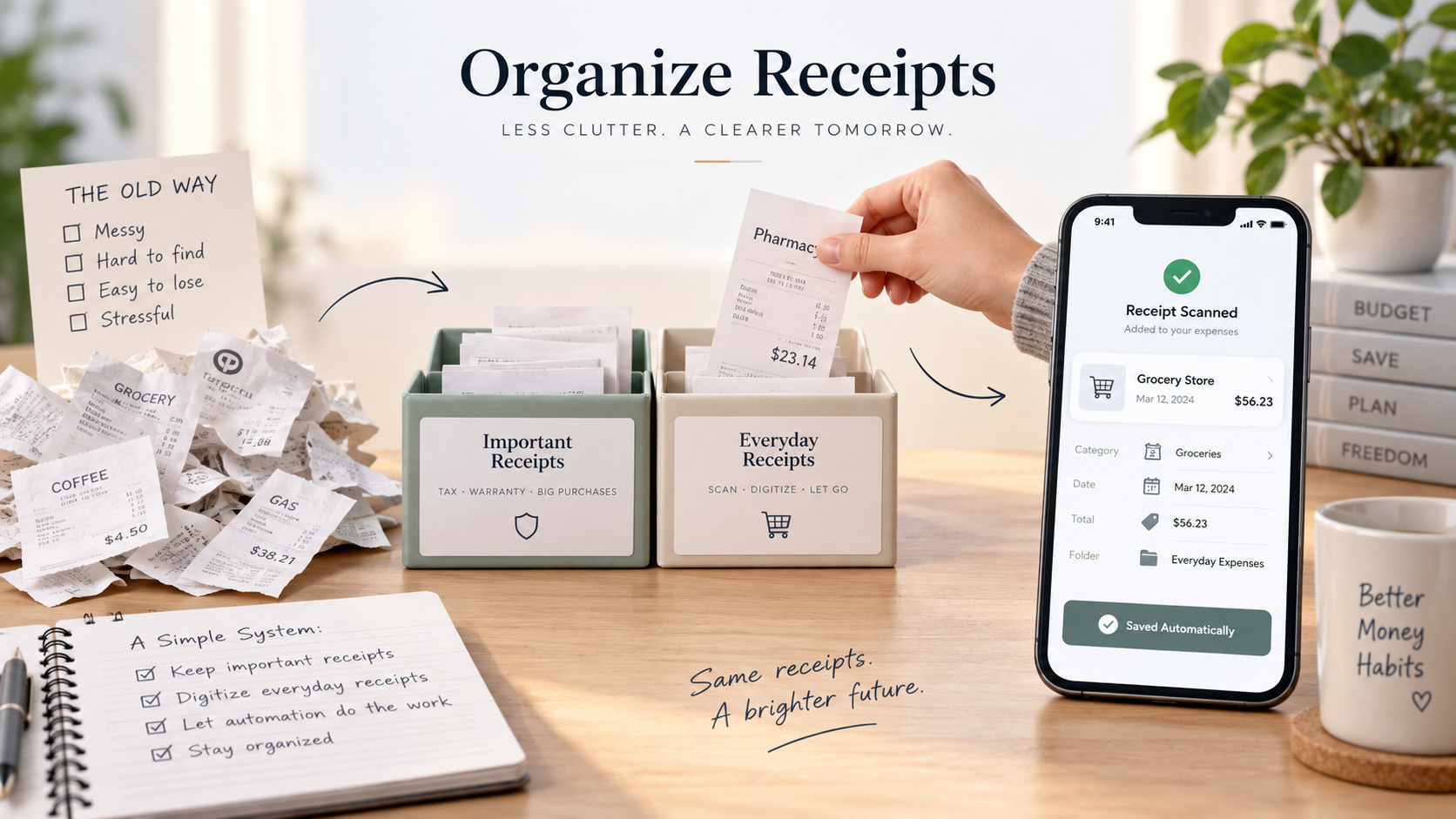
You don't need a filing cabinet. You need four decisions. (If you want the mechanics of setting this up, see our guide to organising receipts.)
Bin it after reconciling. Coffee, transport, groceries. No warranty, no deduction. Hold until the card statement matches, then let it go.
The tax clock. Anything supporting a deduction, a business expense or reported income. Three years US, four to six Spain, five to six UK, and longer if an enquiry opens.
The warranty clock. Electronics, appliances, furniture, tools. Guarantee period plus the claim window. In Spain that realistically means holding the receipt for a major appliance for most of a decade.
The forever-ish pile. Property purchase, renovation invoices, major assets. These stay until you dispose of the asset, plus the tax window afterwards.
The sorting is the entire job, and it's trivial at the moment of purchase and miserable in December. If receipts are captured and categorised as they happen, the buckets mostly assign themselves, and searching for "washing machine, 2026" takes a second rather than an afternoon.
FAQ
Do I need the original paper receipt to make a warranty claim? No. In the UK and Spain the law requires proof of purchase, not one specific document. Bank statements, card statements, order confirmations and electronic invoices all qualify. A retailer's own policy might ask for the till receipt, but it can't override your statutory rights.
Can I throw receipts away after three years? In the US, usually yes for ordinary tax records. Not if you underreported income by more than 25% (six years), claimed a bad-debt or worthless-securities deduction (seven years), never filed, or the receipt relates to property you still own. Check your state as well as the IRS. In Spain and the UK, three years is too short for most categories.
How long should I keep utility bills? UK: two years is a sensible working rule, since suppliers can't back-bill domestic customers beyond twelve months for their own errors. Spain: five years, the limitation period on periodic payments. US: there's no general federal rule, so for an ordinary household bill with no tax, business or dispute purpose, keeping it until the account reconciles is usually enough. If it supports a home-office or rental deduction, it follows the tax clock instead.
Are photos of receipts accepted by tax authorities? Yes, by the IRS, HMRC and Spain's AEAT, provided the copy is complete, legible, unaltered and retrievable for the whole retention period. The exceptions are HMRC's rule on non-VAT tax documents and Spain's certified-digitisation requirement, which only bites if you want to destroy the paper.
How long should I keep receipts if I'm self-employed? Spain: six years, because the commercial period outruns the tax one. UK: five years after the 31 January deadline for that tax year. US: three years as standard, four for employment tax records if you have staff.
Does an audit or enquiry change the deadline? Yes, and this catches people out. Once HMRC opens an enquiry or Hacienda issues a check, the normal retention period stops applying and you keep everything until it's formally closed. Same for amended returns: supporting documents for both the original and the amendment stay live until the new window expires.
What if I moved country during the retention period? The obligation follows the tax year, not your address. Records supporting a Spanish return stay under Spanish rules after you leave. If you've filed in two countries, work to the longer of the two periods, and keep everything digitally, because paper doesn't survive international moves.
Sources
United States
- IRS, How long should I keep records?
- IRS, Publication 463: Travel, Gift, and Car Expenses
- IRS, Revenue Procedure 97-22 (electronic storage of records)
- Uniform Commercial Code, §2-725 (statute of limitations in contracts for sale)
Spain
- Ley 58/2003, General Tributaria, art. 66
- Código de Comercio, art. 30
- Real Decreto Legislativo 1/2007, TRLGDCU, arts. 120 and 124
- Orden EHA/962/2007 (certified digitisation)
United Kingdom
- GOV.UK, Keeping your pay and tax records
- GOV.UK, Business records if you're self-employed
- GOV.UK, Using Making Tax Digital for Income Tax
- Consumer Rights Act 2015
- Ofgem, Ban on back-billing beyond 12 months
General retention rules as of September 2026, checked against the official sources listed above. Not tax or legal advice. Rules change, and individual circumstances such as open enquiries, amended returns and disputed claims extend these periods. Confirm anything specific with a qualified professional or directly with the IRS, HMRC or the Agencia Tributaria.